


Mississippi Baptist Medical Center Student and Faculty Online Orientation
MBMC has 638 licensed beds and is home to Baptist Cancer Center, a six-level tower housing the Cardiovascular Center and Baptist for Women. The hospital has received numerous awards and recognition for its excellent care, including receiving the Platinum Performance Achievement Award from the American College of Cardiology, the American Heart Association’s Get With The Guidelines — Stroke Gold Plus Quality Achievement Award with Target: Stroke Honor Roll Elite Plus and Target: Type 2 Diabetes Honor Roll, and was awarded the Chest Pain Center Accreditation with PCI (Primary Percutaneous Coronary Intervention) by the American College of Cardiology in 2024. MBMC is the only Magnet® designated hospital in Mississippi earning accreditation in 2017 and 2023 and has been chosen as the #1 hospital in Mississippi and in the Jackson area for seven years in a row by US News & World Report.
As a Magnet® designated hospital, we are not perfect but we come to work every day and actively work towards perfection. In that pursuit, we need your help. Come to Baptist ready to impress our patients with your smile, compassion, and quality of care. Our mission statement and CARES model will guide you on your journey.
Mission Statement
In keeping with the three-fold ministry of Christ — Healing, Preaching and Teaching — Baptist Memorial Health Care is committed to providing quality health care.
Vision Statement
To create an expert system of care in the Mid-South where love abounds so that God can do the impossible.
Values
- Compassionate care and service
- Teamwork and trust
- Innovation and excellence
- Respect for the individual and the value of diversity
While completing clinicals at Mississippi Baptist Medical Center you serve as a representative of our team. As a representative, you are expected to adhere to the Baptist CARES principles of service.
C – Continuous improvement of results
A – Alignment and accountability
R – Respect for every person
E – Empathy and compassion
S – Service above self
HIPAA - Health Insurance Portability & Accountability Act
Certain laws and regulations require that practitioners and health plans maintain the privacy of health information. One of the fundamental principles is that access to patient information is limited by the "need to know" rule, which is defined as those individuals that are directly associated with the patient's care. Baptist takes HIPAA regulations very seriously. This law impacts students in the following ways:
- Patient records may not be photocopied or printed from a computer terminal for personal use (i.e. writing care plans or other papers).
- Students must not release any patient information independently.
- Any request for patient information should be directed to your preceptor or nurse assigned to your patient.
- You cannot talk about your patients to anyone other than those who "need to know."
- Violations of HIPAA may result in termination of the student experience.
A signed HIPAA statement of confidentiality is required of all students before any clinical experiences. This form should be printed, signed, and kept at your respective school by the instructors.
Additional Steps to Protect a Patient's Privacy
- Knock before entering a patient's room.
- Close room doors when discussing treatments and administering procedures.
- AVOID discussions about patients in public areas such as the cafeteria lines, halls and elevators.
- Safeguard medical records by not leaving the record unattended in an area where the public can view or access the record.
- If you have logged into a computer system to view or enter data into the medical record, make sure you log off once you are finished.
Professional Image
Goal
To create and present a professional image that helps our patients, members and customers feel safe, confident, and comfortable when they interact with any Baptist employee or student.
Personal Identification
While on campus your school’s name badge must be worn in a visible location on the upper torso at all times.
Personal Appearance
Employees/Instructors/Students are expected to practice personal hygiene such as being neatly groomed and free of body odor or strong perfume/cologne that might interfere with those who are ill or allergic to such odors or fragrances.
Student identification badges must be worn over left chest at all times.
Hairstyles are to be conservative, clean, neat, and in a naturally occurring color. Hair should not inadvertently make contact with patients or customers.
No artificial nails, gel, shellac, ornaments, or extenders are allowed. Natural fingernails are to be clean, conservative, and no more than ¼ inch in length.
Facial tattoos are prohibited. Tattoos, including tattoos on the neck, hands, and arms, must be covered if they depict nudity or profanity, are inflammatory in nature, represent violence, drugs, sex, alcohol or tobacco products, or may otherwise be interpreted as offensive.
With the exception of ear piercings, visible facial and/or body piercings should be removed or will require a flat, flesh/skin colored or clear plug to be utilized. Ear gauges must be plugged with a solid, matching flesh/skin colored retainer. All other jewelry should be small, conservative, and limited as to not interfere with patient care.
Your school uniform is required dress for all clinical experiences. Uniforms should be clean, unwrinkled, well-fitting, and in good repair, upholding professional and departmental appearance standards and safety. Undergarments should be worn as well. Professional dress is required if you are on campus for any reason associated with your clinical experience (education, clinical assignment, etc.). Please note: hoodies, fleece, t-shirts, school sweatshirts, denim, leggings, vented crocs, and flip flops should not be worn while completing any piece of your clinical experience.
Electronic devices are not allowed in patient care areas or where the public can see you. This includes, but is not limited to, the use of earbuds, cellphones, tablets, smart glasses, and headphones.
Student, Faculty and Staff Roles and Responsibilities
It is imperative to have open and clear communication between the staff, students, and faculty. There is a chain of command for each unit. The typical chain of command begins with the nurse assigned to the patient. If there is still cause for concern regarding a patient, family, or staff member, then the charge nurse needs to be notified. If there is still cause for concern, the Nurse Manager is notified if available. If the Nurse Manager is not available, each area has an assigned Clinical Director. The Chief Nursing Officer, Brenda Howie, is the next level in the chain of command. If you have any questions regarding the chain of command, please contact Hospital Administration at 601-973-1661.
Staff retain responsibility for patient care, recognizing that students will not replace Baptist staff or give service to patients apart from their educational level. Staff will initiate frequent communication with students/faculty regarding the care for the assigned patient(s).
Students/Faculty
- Will adhere to general rules, polices and regulations of Baptist.
- Work in collaboration with staff members who retain responsibility for the patient.
- If a patient refuses medication or treatment, the student should notify the nurse and document refusal with name of nurse notified.
- Pt refused aspirin, Florence, RN notified of patient refusal.
- All controlled meds must be administered, returned, or wasted by the RN who removes the medication from the Omnicell. Student nurses administered controlled medications only with the supervision of an instructor or licensed personnel.
- All controlled meds must be administered within 30 minutes from withdrawal.
- Partial waste dosing of ALL controlled meds must be done prior to administration (at the time of removal from the Omnicell). This requires an RN witness.
- Instructors should verify Epic and Omnicell documentation of all controlled substances is accurate prior to leaving the unit each day.
- Student nurses may assess restraints, but student nurses/faculty may not initiate, apply, remove, or tie restraints.
- Verify you are connecting to the correct device prior to accessing. Trace lines, tubing, and connections back to their source. Forcing a connection is the first clue that there is a problem. Stop and ask the primary nurse for assistance.
- Some patients require additional security measures. If you encounter a “Break the Glass” message, please consult the primary nurse prior to proceeding.
- Keep staff informed of a patient's status and immediately inform the patient care provider of significant changes in a patient's condition.
- Students will respectfully support the patient's rights and will inform the nurse immediately whenever a patient requests the student not to participate in their care.
- Students must inform the assigned nurse when leaving the unit on a break.
- Students will give a verbal summary of their care to the assigned nurse before leaving the unit and document the handoff in the Electronic Medical Record.
- Students will work within their level of education/skill and within the guidelines of the Student Nurse Skill Exclusion List. If the student is not able to competently perform the skills assigned, they should not attempt the skill and should immediately inform the nurse. Seek guidance as needed to perform skills.
- Students/Faculty will utilize the materials and/or orientations provided to become knowledgeable of facility guidelines and ask questions when clarification or more information is needed.
- Illness or Injury while on campus: Baptist Health Systems will provide immediate first aid for work related injuries or illnesses such as needle sticks to students. The cost of immediate first aid will be billed to the student's insurance carrier, but the student shall assume the responsibility for payment for such charges.
Electrical Safety
Never use a loose wall plug, extension cord, cheater plug, or cord that is bent, frayed, cracked or exposed. Notify primary nurse immediately if an electrical safety concern is identified.
Infection Prevention
- Hand hygiene #1 way to prevent HAIs. Staff/Students are required to perform hand hygiene in accordance with Centers for Disease Control and Prevention (CDC) recommendations.
- Students and Personnel should use an alcohol-based hand rub or wash with soap and water for the following clinical indications:
- Immediately before touching a patient
- Before performing an aseptic task (e.g., placing an indwelling device) or handling invasive medical devices
- Before moving from work on a soiled body site to a clean body site on the same patient
- After touching a patient or the patient’s immediate environment
- After contact with blood, body fluids, or contaminated surfaces
- Immediately after glove removal
- Wash hands with soap and water when visibly soiled, before eating, after using restroom and when after contact with a patient under enteric precautions
Body Mechanics
- You must observe and practice the hospital’s safety rules. All injuries must be reported immediately to your supervisor or instructor, and an occurrence report must be completed.
- Using good body mechanics minimizes the risk of injury. Safe work practices should be observed.
- Get a firm footing, feet apart.
- Bend your knees, not your back.Bend your knees, not your back.
- Tighten stomach muscles; they support your spine when you lift.
- Lift with your legs.
- Keep the load close.
- Keep your back upright.
- Move your feet, don’t twist.
- Get plenty of help.
- Know your job and what you are doing.
- Know how to operate equipment.
- Put item to be moved at proper height (i.e., adjust bed height).
- Have a plan for the lift; coordinate with counting.
- Prepare for the unexpected.
- Lift with your mind before you lift with your body.
- If you protect yourself, you protect others.
- Change positions often.
Parking
- Mississippi Baptist Medical Center is a tobacco-free facility. The use of tobacco products is prohibited on hospital premises.
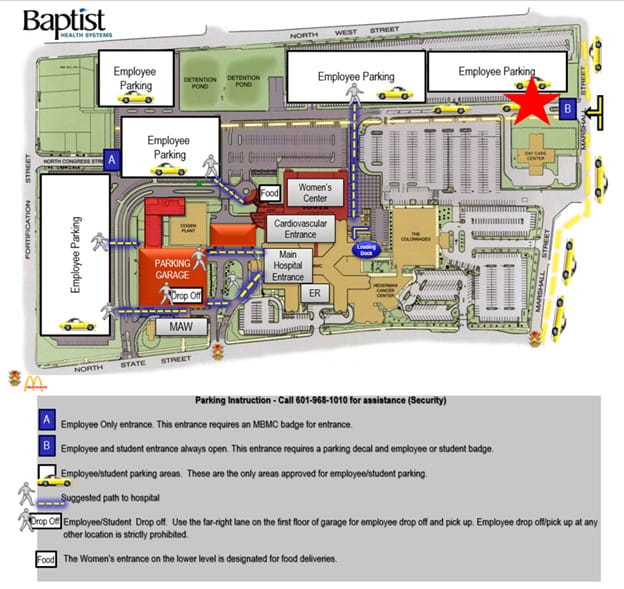
- Neither students nor faculty are allowed to park in the parking garage.
- From the very first day on campus, students and faculty must park in the employee parking lot to the South or Southwest of the campus. Refer to the map for more parking information.
- All students and faculty will enter from Marshall street. A parking decal and school badge will be required for entry. Please have your school badge out prior to arriving at the gate.
Security and Safety
Your safety is of utmost importance to us.
Our campus is covered with hundreds of cameras and a professionally trained, full-time security staff 24/7.
However, we cannot provide a locker for you to secure your valuables while in the building. Do not bring any valuables to campus except for the cash to buy a meal. Before leaving home, place your purse, portable electronic items or backpack in the trunk of your car.
Feel free to call Security for any questions or safety concerns at 601-968-1010.
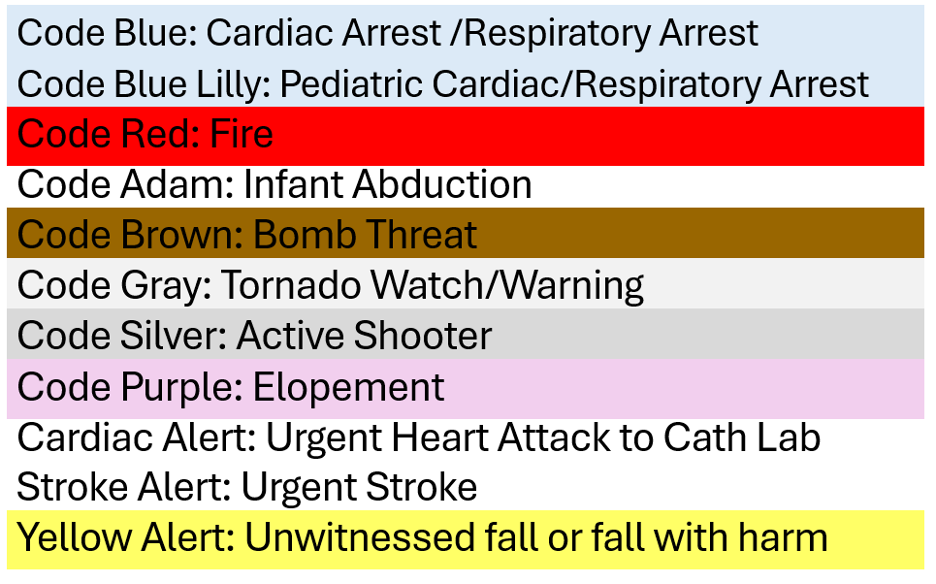
Emergency Codes
Food Service
Cafe' 1225
Located on the first floor just off the main hospital lobby.
Daily cafeteria hours are 6:15 a.m. to 2:00 a.m.
Chick-fil-A is located in the Atrium.
Coffee Shop
Located on the first floor in the main hospital lobby.
Monday- Friday: 6:00 a.m. to 8:30 p.m.
Saturday-Sunday: 7:00 a.m. to 6:00 p.m.
| First Floor | |
| Emergency Room | 601-968-1700 |
| 1 North, Stepdown | 601-968-1800 |
| Central Intake | 601-968-1228 |
| Monitor Station | 601-968-1162 |
| Second Floor | |
| OCU | 601-968-1155 |
| Cath Lab | 601-968-1013 |
| Endoscopy/GI Lab | 601-968-1027 |
| Same Day Surgery | 601-968-1424 |
| Surgery – OR | 601-968-1190 |
| 2N CVR (West Tower) | 601-968-1484 |
| 2N ICU West (West Tower) | 601-968-1485 |
| Lab | 601-968-3070 |
| Third Floor | |
| 3A Senior Behavioral Health | 601-968-1031 |
| 3B Medical | 601-968-1032 |
| 3C ICU North | 601-968-1033 |
| 3D ICU-East | 601-968-1034 |
| 3N Cardiac (West Tower) | 601-968-1801 |
| 3S Cardiac (West Tower) | 601-968-1802 |
| Fourth Floor | |
| 4A Med-Surg | 601-968-1041 |
| 4B Med-Surg & Pediatrics | 601-968-1042 |
| 4C Labor and Delivery | 601-968-1043 |
| 4D Neuro/Stroke | 601-968-1044 |
| 4N NICU (West Tower) | 601-968-1045 |
| 4S Mother/Baby (West Tower) | 601-960-1803 |
| Fifth Floor | |
| 5C Med-Surg | 601-968-1053 |
| 5D Oncology | 601-968-1054 |
| 5N Surgical (West Tower) | 601-968-1804 |
| 5S Urology (West Tower) | 601-968-1805 |
| Sixth Floor | |
| 6A Medical | 601-968-1061 |
| 6B Medical | 601-968-1062 |
| 6C Med Surg Plastics | 601-968-1063 |
| 6D Med-Surg Orthopedics | 601-968-1064 |